Published on
Asking rents crept up slightly in February, according to the latest Apartments.com rent growth report, but the rise remained muted. Constrained by elevated supply and insufficient demand, annual rent growth in February decelerated from 0.6 percent in January to 0.4 percent.
Monthly rent growth nearly flattens
Historically, rents rise month over month at the beginning of the year as they begin to rebound following a late fall slowdown. From 2010 to 2025, the month of February has seen an average 0.3 percent increase over the previous month.
In contrast, this year’s monthly increase was a mere 0.1 percent, or $2 per unit. As of February, the asking rent averaged $1,716 nationwide.
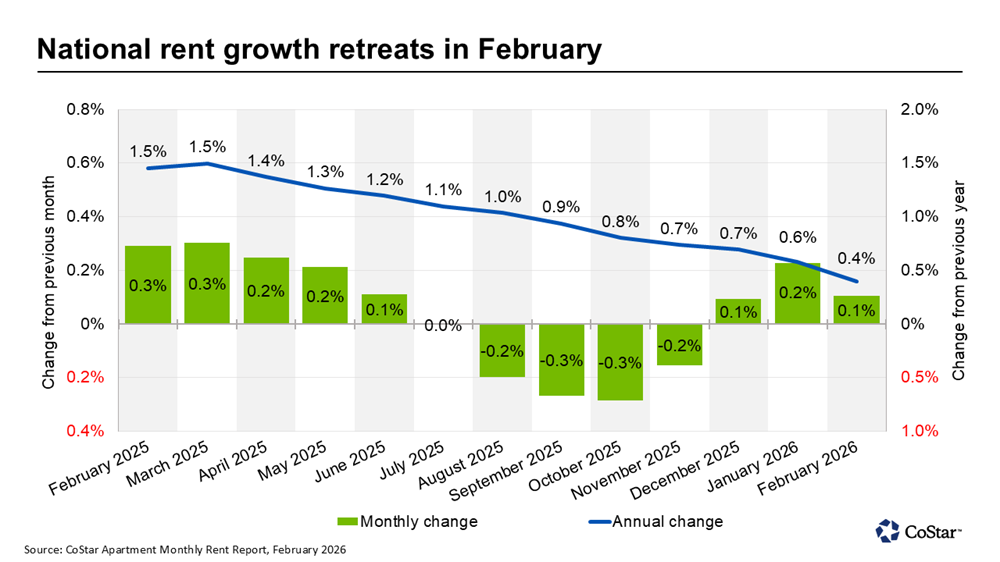
The deceleration of annual rent growth to 0.4 percent marked a notable drop. Rent growth had hovered around 0.7 percent for most of the fourth quarter.
Why is rent growth so restrained?
After peaking at a 40-year high in 2024, supply remains elevated this year. Multifamily development boomed during and following the pandemic, and many markets continue to struggle to absorb the excess units that have been delivered since.
At the same time, renter demand has failed to make up the difference. Absorption has fallen since 2024, a result of the recent slowdown in population growth and the softening job market.
Which local markets are over- and underperforming the national average?
The trends suppressing rent growth at the national level hold true for individual markets as well.
The few metropolitan areas where rent growth has taken off have benefited from supply constraints and strong job markets, while those with the most dramatic declines have seen high levels of construction, sometimes also paired with weakening local economies.
For example, San Francisco, retained its #1 spot for annual rent growth in February, with rent growth of 5.7 percent. This high-performing market has topped the charts since mid-2025, owing to limited new development and a booming AI sector. In February, San Francisco posted rent growth over 14 times the national average.
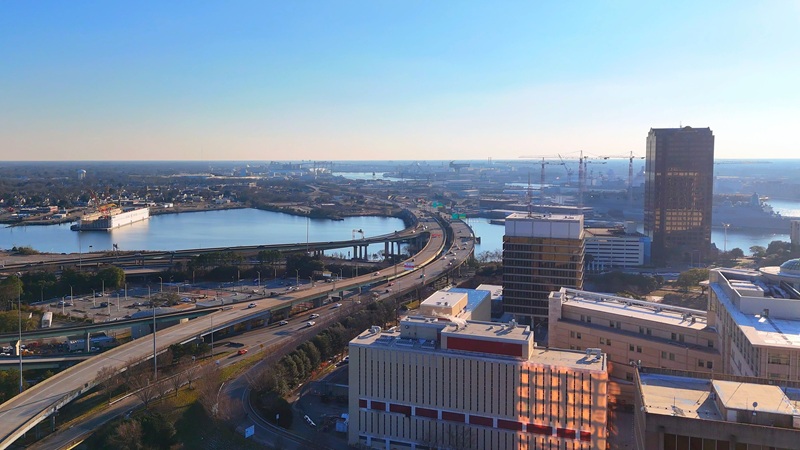
Norfolk, Virginia, came in second place, with rent growth of 4.1 percent, over 10 times the national average. February marked the third consecutive month that Norfolk has taken the #2 spot.
Also known as the Hampton Roads market, Norfolk is home to the Port of Virginia and Naval Station Norfolk, which have contributed to strong renter demand. The Norfolk multifamily market has enjoyed relatively strong performance as result of limited multifamily development in the area and a healthy local economy.
San Jose, a neighboring market south of San Francisco, took the third spot, where it has remained for much of 2025 and 2026. Benefiting from the same factors as San Francisco, tech-heavy San Jose posted rent growth of 3.5 percent.
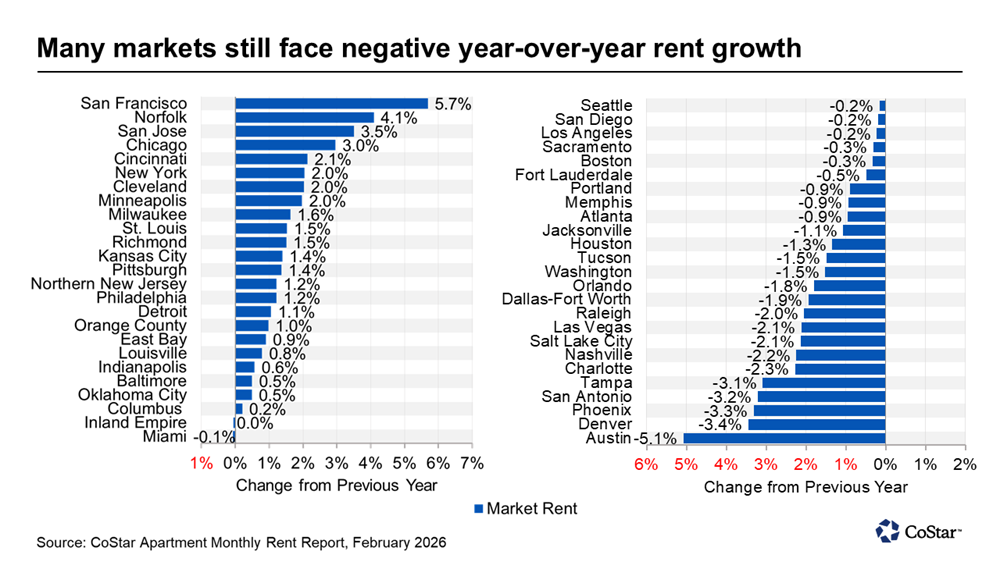
On the other hand, Austin continues to underperform the national average more significantly than any other major market. Austin, which experienced one of the biggest multifamily development booms during the pandemic, saw rents fall 5.1 percent between February 2025 and February 2026.
Denver came in second to last, with an annual rent decline of 3.4 percent, and Phoenix took the third spot with rents dropping by 3.3 percent. Like in Austin, rent growth in these markets has been driven down by a glut of new units pushing vacancy rates above 12 percent, according to the latest CoStar data.
Explore more multifamily insights
What’s ahead for the multifamily market this year? Get the outlook for 2026, along with the highlights of last year, in a recent webinar with CoStar analyst Grant Montgomery, available on demand.
Watch now: